I have been thinking about what programming languages are really for.
In the 70s and 80s, humans had ideas and computers had machine code. Languages evolved in the middle — COBOL read like structured English, C stayed close to the metal, Python moved further toward how people describe steps. Same job, different distance from the hardware. Go, Rust, and Kotlin came later with their own trade-offs: simplicity, safety, or less boilerplate on the JVM.
What I have noticed with AI-assisted coding is that AI is adding another hop. It used to be human → language → machine. It is becoming human → AI → language → machine.
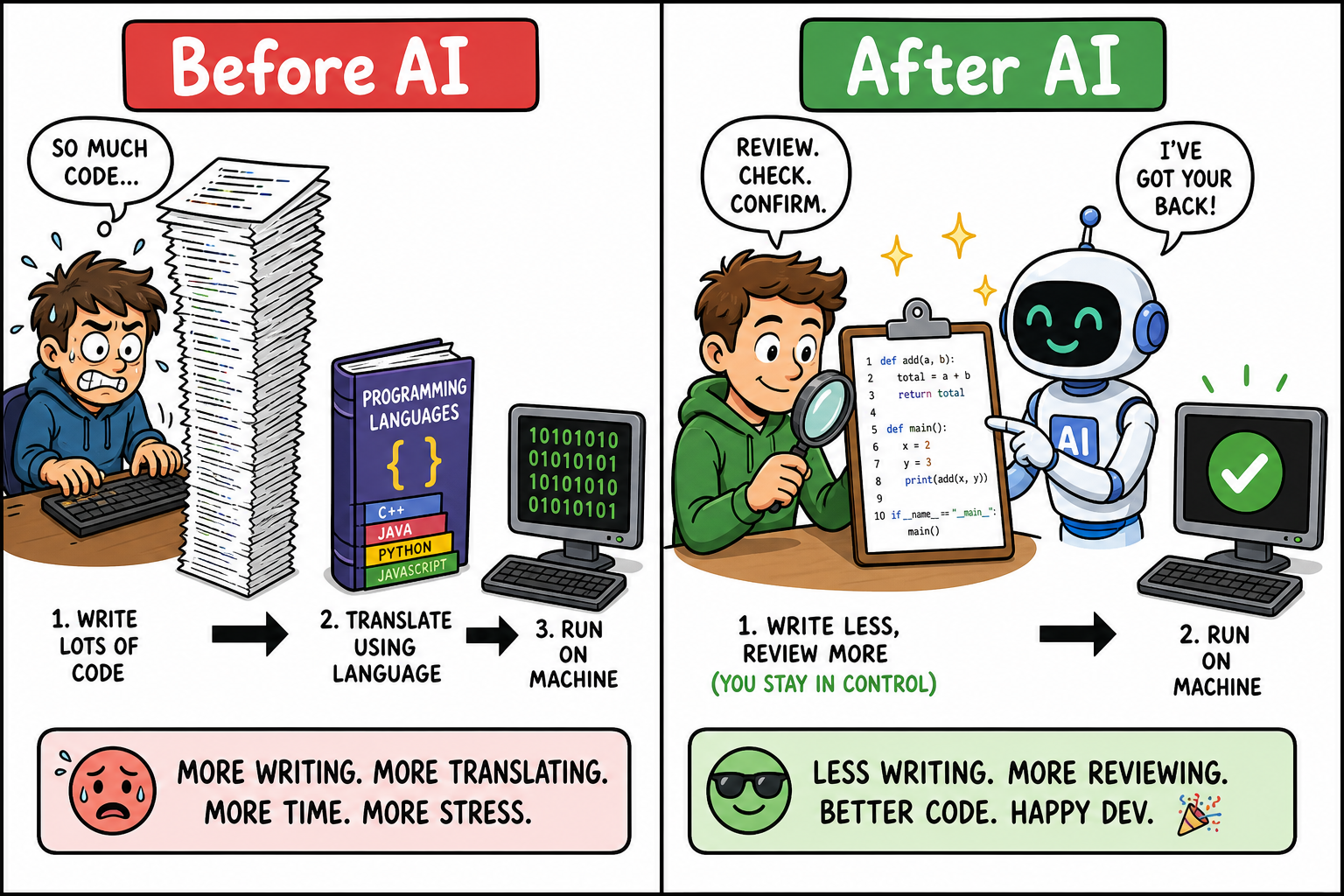
The human still sets the goal and catches what is wrong. In my experience, the human is still the pilot — AI is the copilot. What changes is how much typing and reviewing a person has to do.
If the model drafts the code, long boilerplate becomes expensive for both sides. That is why structured languages like Rust and Kotlin make more sense to me now. You can say a lot in a short passage, the compiler catches mistakes early, and the machine still gets optimized output whether a person or a model typed the source.
Python, Go, and Rust each still have a place. But in an AI-assisted world, I would bet on languages that are easy to review and hard to get wrong — not necessarily the chattiest ones.